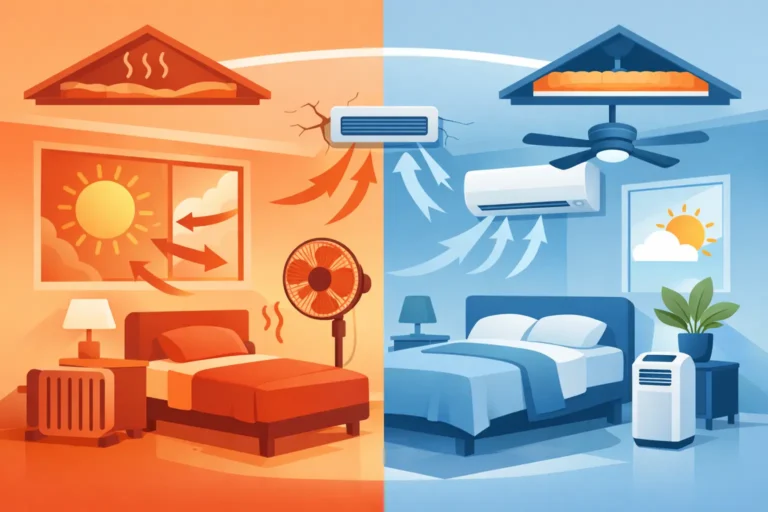

A thermostat can read 72 degrees while one bedroom still feels like a sauna. If you are asking, “why does my room stay hot,” the answer is usually not that your air conditioner has stopped working altogether. More often, that room is receiving too much heat, not getting enough conditioned air, or losing the cool air it receives before you can feel it.
In Orange County and the Inland Empire, long sunny afternoons, upstairs floor plans, older ductwork, and rooms with large west-facing windows can all make the problem worse. The good news is that an uncomfortable room is often diagnosable. The right fix depends on whether the issue is airflow, insulation, equipment sizing, or a combination of factors.
Why Does My Room Stay Hot When the AC Is Running?
Your central AC cools the home through a connected system. The thermostat signals the equipment, the blower moves air through the ducts, and each room receives its share through supply vents. When one space stays hot, something is disrupting that balance.
A room that is 2 to 4 degrees warmer than the rest of the house may need an airflow adjustment or help blocking solar heat. A room that is consistently 8 to 10 degrees hotter can point to a more significant duct, insulation, zoning, or HVAC design issue. Start by noticing when the problem happens: only in the afternoon, all day long, only when doors are closed, or even at night. That pattern gives useful clues.
The room gets more direct sun than the rest of the home
Sun exposure is one of the most common reasons for a hot room. West- and south-facing windows can bring in substantial heat during Southern California afternoons, especially when a room has large panes of glass, aging windows, dark blinds, or little exterior shade.
Your AC may be delivering cool air as designed, but the heat gain can outpace it. Close blinds or curtains before the sun reaches the windows rather than after the room has already heated up. Cellular shades, solar screens, window film, and insulated window coverings can help. Exterior solutions, such as awnings or strategically placed shade, are often even more effective because they stop heat before it reaches the glass.
The room is not getting enough supply air
Put your hand near the supply vent while the AC is running. You should feel a steady stream of cool air. Weak airflow can result from a closed or partially closed vent, a blocked register, a crushed or disconnected duct, dirty equipment, or an improperly balanced duct system.
Check that furniture, rugs, curtains, and toys are not blocking vents. Also make sure the vent damper is open. Avoid the temptation to close vents in cooler rooms to force more air into the hot room. That approach can raise pressure in the ducts, reduce system performance, and create new comfort problems elsewhere.
If airflow is weak only in one room, the duct serving that room deserves a closer look. Duct leakage is particularly common in attics, garages, crawlspaces, and other unconditioned areas. Cool air can escape before it reaches the register, while hot attic air may be drawn into the system.
The room cannot return air to the system
Air has to circulate, not just enter the room. Supply vents deliver conditioned air, while return vents pull air back to the HVAC system to be cooled again. Many bedrooms have no dedicated return vent and rely on the gap beneath the door for airflow.
If the room becomes hot mainly when the door is shut, poor return airflow may be the culprit. A closed door can trap air inside, making the room feel stuffy and limiting how much cooled air can enter. Do not cut or modify doors yourself. An HVAC professional can assess whether a return-air pathway, transfer grille, jump duct, or another solution makes sense for your home.
Heat is coming through the ceiling, walls, or attic
Top-floor bedrooms and bonus rooms frequently run hot because the ceiling sits directly below a very warm attic. Insufficient attic insulation, gaps around recessed lights, missing duct insulation, and air leaks around fixtures can all allow heat into the living space.
This problem is often most noticeable late in the day. Even after the sun moves, the attic and building materials can continue releasing stored heat into the room. An HVAC inspection can identify duct concerns, while a qualified insulation or home-performance assessment may reveal where the building envelope needs attention. Both sides matter: the home should keep heat out, and the HVAC system should distribute cooled air properly.
The thermostat is in a cooler part of the house
Your thermostat controls the system based on the temperature where it is located, not on the hottest room. If it sits in a shaded hallway or downstairs living area, it may be satisfied while an upstairs bedroom remains uncomfortable.
Smart thermostats with remote sensors can be useful for some households because they can prioritize an occupied bedroom during certain hours. Still, a sensor does not create more cooling capacity or repair poor ductwork. It is a comfort-control tool, not a substitute for correcting the root cause.
Other HVAC Problems That Can Leave One Room Hot
Sometimes the hot room is an early warning sign that the overall system needs service. If every room feels warmer than usual, cooling cycles run longer, or the air coming from several vents is not very cool, schedule an AC inspection rather than focusing only on the problem room.
A dirty air filter can restrict airflow throughout the home. Filters should fit correctly and be replaced on the schedule recommended for your system and household. Homes with pets, construction dust, allergies, or frequent AC use may need more frequent changes. An overly restrictive filter can also reduce airflow, so use the filter type your HVAC professional recommends.
Other possible causes include a dirty evaporator coil, a blower problem, low refrigerant from a leak, or an aging system that cannot keep up with current cooling demands. These are not DIY repairs. Refrigerant and electrical work require trained technicians, and simply adding refrigerant without locating a leak is not a lasting solution.
An oversized or undersized system can both create comfort issues
An undersized AC may struggle during the hottest part of the day, especially after a remodel, room addition, window upgrade reversal, or increased sun exposure from removed trees. An oversized system has a different problem: it can cool the thermostat area too quickly, shut off early, and leave distant rooms warm or humid because it does not run long enough to distribute air evenly.
That is why replacing equipment based only on square footage is risky. A proper recommendation considers insulation, window orientation, ceiling height, occupancy, duct condition, and the home’s actual cooling load. In some homes, a ductless mini-split for a difficult room is more practical than changing the entire central system. In others, duct sealing, balancing, or insulation improvements offer the better value.
What You Can Check Before Scheduling Service
A few simple observations can help narrow down the issue without taking apart equipment. Check whether the supply vent is fully open and unobstructed. Compare airflow in the hot room with airflow in a nearby comfortable room. See whether the room improves when its door is open. Pay attention to direct afternoon sun, and look for obvious gaps around windows or attic-access points.
Also check the air filter if you are comfortable doing so. If it is visibly loaded with dust or past its replacement date, install the correct new filter. Do not remove the filter and run the system without one, since that can allow debris to collect on sensitive components.
If you notice ice on refrigerant lines, water near the indoor unit, burning smells, buzzing, repeated breaker trips, or no cool air from multiple vents, turn the system off and request professional service. Continuing to run a malfunctioning system can cause further damage.
When a Professional Comfort Assessment Is Worth It
A technician can measure airflow, inspect accessible ducts, check static pressure, evaluate temperature differences, and look for equipment performance concerns. This is more useful than guessing at a single fix, particularly in homes with additions, converted garages, vaulted ceilings, multiple stories, or rooms far from the indoor unit.
For homeowners and property managers in Orange County and the Inland Empire, Just Right Services can evaluate whether the answer is AC repair, duct sealing, duct cleaning where appropriate, system balancing, insulation coordination, or a room-specific comfort option such as a mini-split. Clear findings matter because the least expensive repair is not always the one that solves the room’s heat problem.
A hot room does not have to become the room everyone avoids each summer. Track when it gets hot, make the simple airflow and shade checks, and have the system evaluated if the difference persists. A well-diagnosed fix can make that space feel like part of the home again.