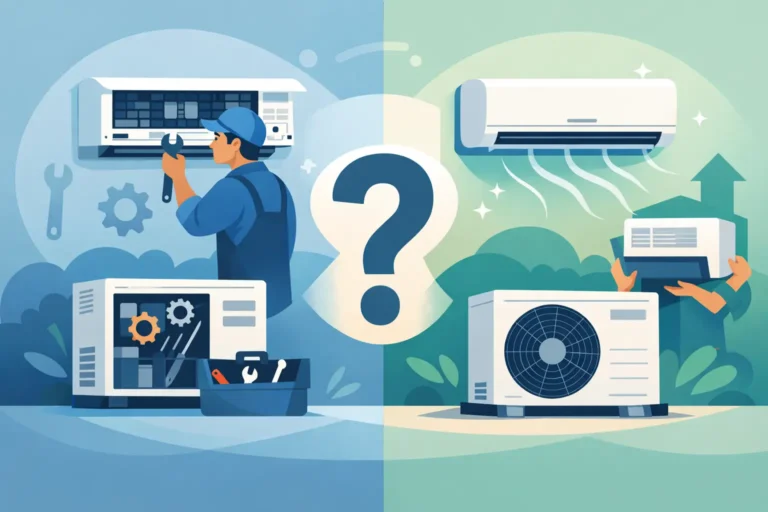

A struggling AC usually picks the worst possible week to act up. When your system starts blowing warm air in a Laguna Hills heat wave or short cycling through a humid afternoon in Irvine, the real question shows up fast: should you repair or replace air conditioner equipment now, or can it reasonably give you a few more seasons?
That answer depends on more than one repair bill. Age, energy use, refrigerant type, repair history, indoor comfort, and how long you plan to stay in the property all matter. For homeowners, landlords, and property managers across Orange County and the Inland Empire, the smartest decision is usually the one that balances immediate cost with long-term reliability.
How to decide whether to repair or replace air conditioner equipment
The first thing to look at is the age of the system. Most central air conditioners last around 10 to 15 years, though maintenance, installation quality, and local climate can move that range up or down. In Southern California, long cooling seasons and heavy summer demand can wear a unit faster than many owners expect.
If your AC is under 10 years old and the issue is isolated, repair is often the better value. A failed capacitor, contactor, thermostat, or fan motor can usually be fixed without turning the job into a full replacement conversation. When the system has been maintained and the repair cost is reasonable, keeping it running makes sense.
Once the system gets into the 12- to 15-year range, the math starts to change. Even if you can repair it, that does not always mean you should. Older systems tend to lose efficiency, struggle to keep temperatures even, and become more expensive to maintain year after year. At that point, replacement may be the more predictable investment.
When repair is usually the right move
Repair is often the practical choice when the problem is clear and limited. If the unit has generally cooled well, your utility bills have stayed stable, and this is the first meaningful repair in years, fixing it is usually reasonable.
This is especially true when the cost of repair is small compared to the cost of a new system. Many homeowners use a version of the 50 percent rule: if the repair is less than half the price of replacement, and the system still has useful life left, repair is worth considering. It is not a perfect rule, but it gives a useful starting point.
Repair also makes sense if the issue is affecting a newer, higher-efficiency system. Replacing a relatively modern unit after one failed part is usually unnecessary. In those cases, a professional diagnosis can restore comfort quickly without overcomplicating the decision.
For landlords and commercial property managers, repair may be the right short-term move when budget timing matters and the system is still serviceable. The key is being honest about whether the repair solves the problem or simply delays a larger one.
Signs your AC is still a good candidate for repair
Your air conditioner may still be worth repairing if it is less than 10 years old, uses current refrigerant, has not needed repeated service, and still cools the space evenly once the issue is fixed. Mild airflow problems, electrical component failures, clogged drain lines, and thermostat faults usually do not justify replacement on their own.
A good technician should be able to tell you whether the repair restores dependable operation or whether other major components are also nearing failure. That distinction matters.
When replacement starts to make more sense
If your AC has become unreliable, inefficient, or expensive to keep alive, replacement is often the better call. The biggest mistake many property owners make is approving one more repair every summer until they have spent a substantial amount on a system that still cannot deliver dependable comfort.
Frequent breakdowns are one of the clearest warning signs. If you have had multiple repairs in the last two years, the issue is probably not bad luck. It may be a system that is simply wearing out.
Higher energy bills are another clue. Air conditioners lose efficiency as components age, coils get dirty, motors weaken, and refrigerant performance drops. If your cooling costs are rising without a major change in usage, an older unit may be working much harder than it should.
Comfort issues also matter. If some rooms stay warm, humidity feels higher than normal, or the system runs constantly without really catching up, replacement can improve more than temperature alone. A properly matched new system can make the home feel more consistent, quieter, and easier to manage during peak summer heat.
Repair or replace air conditioner systems with R-22 refrigerant
If your system uses R-22 refrigerant, replacement deserves serious consideration. R-22 has been phased out, which means it is much harder and more expensive to source. A repair involving a refrigerant leak on an R-22 unit can turn into a costly short-term fix for an aging system.
In that situation, many owners are better served by putting repair dollars toward a new, more efficient system rather than investing heavily in outdated equipment.
The cost question most people really want answered
Everyone wants a simple number, but the better question is cost over time. A repair may be cheaper today, while replacement may cost less over the next five to ten years when you factor in energy savings, reduced repairs, warranty protection, and fewer emergency service calls.
For example, replacing a worn-out system can lower monthly cooling costs, especially if your existing unit is older and inefficient. That matters in areas like Mission Viejo, Lake Forest, and Rancho Cucamonga, where summer demand can keep ACs running for long stretches. If the current system is already struggling, the monthly operating cost can quietly add up.
That said, replacement is not automatically the right answer for every older unit. If a 12-year-old system has been well maintained and only needs a minor repair, it may still be worth fixing. The right decision comes from looking at the whole picture, not just the date on the data plate.
Questions to ask before you approve either option
Ask how much useful life the system likely has after the repair. Ask whether the failing part is a one-time issue or part of a larger pattern. Ask whether the equipment is properly sized for the home or building, because an oversized or undersized system can create repeat comfort problems that repairs will not solve.
It is also worth asking about indoor air quality and duct performance. Sometimes the AC itself is not the only problem. Leaky ductwork, poor airflow, dirty coils, and neglected maintenance can make a decent system perform like a failing one. A thorough inspection helps you avoid replacing equipment when the real issue sits elsewhere.
For budget planning, ask about financing options if replacement is recommended. Many homeowners put off replacement because the timing feels bad, not because the system is worth saving. Having a payment option can make the better long-term decision more manageable.
A local factor Southern California owners should not ignore
In our region, air conditioners work hard for long stretches, and comfort expectations are high. Homes with large west-facing windows, older insulation, or uneven duct systems often put added stress on cooling equipment. That means a system that might limp along in a milder climate may become a constant frustration here.
For busy households and occupied rental properties, reliability matters just as much as raw efficiency. If you are scheduling service every time temperatures spike, replacement can be the more affordable option simply because it reduces disruption. That is often the point where a customer stops asking, “Can this be fixed?” and starts asking, “What will keep this property comfortable without surprises?”
A trustworthy HVAC company should not pressure you either way. The right recommendation should be based on the condition of your equipment, the cost of the repair, your long-term plans, and your comfort goals. At Just Right Services, that means clear communication, honest guidance, and solutions that fit the property instead of a sales script.
If you are stuck between repair and replacement, the best next step is a full evaluation from a qualified technician who can show you the trade-offs plainly. Sometimes the right answer is a straightforward repair. Sometimes replacement saves you from another summer of uneven cooling, high bills, and repeat breakdowns. The goal is not the biggest job – it is the right one for your home or building.